
Phone Use at the Wheel and Other Distraction Myths Debunked

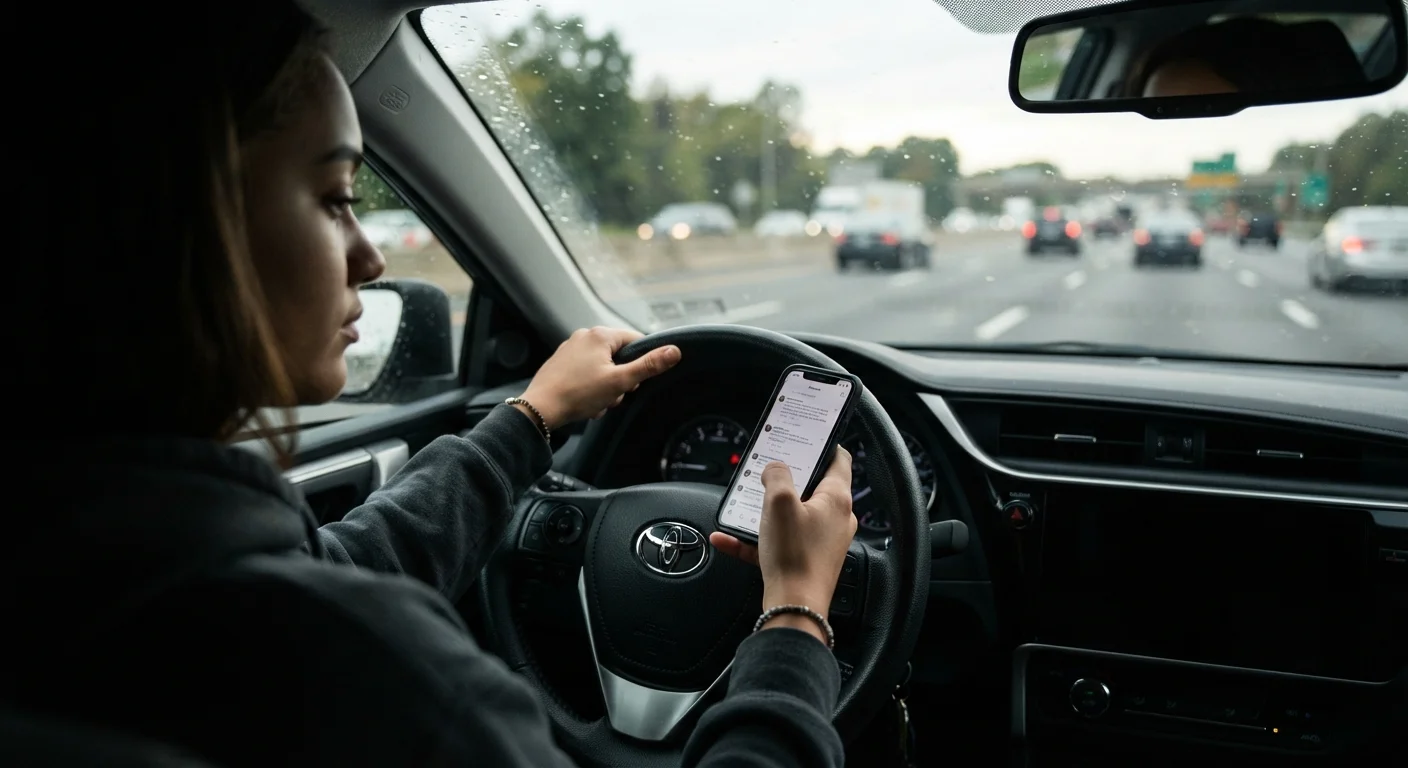
Photo: InsightsTurbo.com | Kickstart Your Knowledge Quest editorial
Key Takeaways
- Hands-free phone calls still impair driving performance - the cognitive distraction is the primary danger.
- A two-second glance away from the road at highway speed covers the length of a basketball court.
- US law treats handheld phone use while driving as a serious infraction in most states.
- Mental distraction persists for up to 27 seconds after finishing a voice-to-text message.
- Experience does not protect drivers from distraction - even skilled drivers lose significant reaction time.
Why Distraction Myths Are Dangerous on Real Roads
Most new drivers learn the basics - mirror checks, lane discipline, speed limits - but distracted driving is one area where dangerous misconceptions tend to fill the gaps left by formal instruction. The problem isn't ignorance so much as plausible-sounding half-truths that feel reasonable until they're tested against crash data.
Research consistently places distracted driving among the leading contributors to road crashes in the United States. The National Highway Traffic Safety Administration (NHTSA) tracks distraction-related fatalities annually, and the numbers remain significant despite decades of public awareness campaigns. Understanding exactly why certain behaviors are risky - not just that they are - helps drivers make smarter real-time decisions behind the wheel.
If you're building your foundational knowledge as a new driver, our complete roadmap to safe, confident driving covers the broader picture. This article focuses specifically on the misconceptions that give distraction a false reputation for being manageable.
Myth
Hands-free phone calls are safe because both hands stay on the wheel.
Fact
Hands-free calls still cause significant cognitive distraction - the hands aren't the main problem, the divided attention is.
The danger of phone use while driving isn't primarily about hand placement - it's about where your mind is. Research by the AAA Foundation for Traffic Safety found that voice-based tasks, including hands-free calls, create measurable cognitive impairment lasting up to 27 seconds after the task ends. During an active call, drivers miss visual cues, react more slowly to brake lights, and scan less of the road ahead. A conversation with a passenger is generally less distracting because a passenger can see traffic and instinctively pause during complex moments - a phone caller cannot.
Myth
A quick glance at my phone only takes a second and can't do much harm.
Fact
At highway speed, a two-second glance means traveling over 175 feet - roughly the length of a basketball court - without processing the road.
The math here is straightforward and alarming. At 65 mph, a vehicle covers approximately 95 feet per second. A glance that feels instantaneous to the driver - say, two seconds to read a notification - means the vehicle has traveled nearly 190 feet with the driver's visual attention elsewhere. That's enough distance to pass through an intersection, close on a braking vehicle, or miss a pedestrian stepping off a curb. NHTSA data defines five seconds as the average time a driver's eyes are off the road when sending a text - at highway speed, that's equivalent to crossing an entire football field blind.
Myth
Experienced drivers can handle distractions better than new drivers.
Fact
Experience does not meaningfully protect against the cognitive and visual impairment caused by distraction.
It's true that experienced drivers handle routine driving tasks more automatically. However, that automation does not extend to processing an unexpected hazard while simultaneously managing a conversation or navigating a phone screen. Studies using driving simulators have consistently shown that experienced drivers suffer the same reaction-time deficits as newer drivers when cognitively distracted. What experience can provide is better hazard-anticipation - but that advantage is nullified when attention is divided. Overconfidence in one's own ability to multitask is itself a documented risk factor among experienced drivers.
Myth
Using voice-to-text is basically the same as keeping your eyes on the road.
Fact
Voice-to-text reduces visual distraction but introduces significant cognitive distraction, and it often requires glances to correct errors.
Voice-to-text technology was widely assumed to solve the distraction problem by keeping eyes forward. The AAA Foundation's research challenged this assumption directly: composing and reviewing voice-generated messages rated as a high cognitive distraction - category 3 out of 5 - in their distraction scale. The mental effort of formulating a message, monitoring whether it was transcribed correctly, and deciding whether to correct errors all draw on the same attentional resources needed to drive safely. In practice, drivers using voice-to-text also frequently glance at the screen to verify the output, reintroducing visual distraction.
Myth
Eating, adjusting the radio, or talking to passengers is fine - it's only phones that are dangerous.
Fact
Any activity that redirects visual, manual, or cognitive attention from driving is a form of distraction with real crash risk.
Distraction is formally categorized into three types: visual (eyes off road), manual (hands off wheel), and cognitive (mind off driving). Eating while driving involves all three when unwrapping food or reaching for a drink. Adjusting infotainment controls - even built-in touchscreens - can take visual attention away from the road for several seconds. NHTSA data links non-phone secondary tasks to a meaningful share of distraction-related crashes. Phones attract disproportionate attention partly because they're engineered to be engaging, but they don't have a monopoly on causing distraction-related incidents.
What the Evidence Actually Tells Us
A consistent thread runs through distraction research: human attention is a finite, singular resource. The brain does not truly multitask - it switches rapidly between tasks, and each switch carries a cost. At 65 mph, that cost is measured in feet traveled while effectively blind to the road ahead.
~3,300
US distraction-related traffic fatalities in a recent year
The NHTSA has reported approximately this number of distraction-related deaths annually in recent years, based on crash data from police reports.
27 sec
Cognitive distraction after completing a voice task
AAA Foundation for Traffic Safety research found drivers remain measurably impaired for up to 27 seconds after finishing a hands-free voice-to-text task.
5 sec
Average eyes-off-road time when texting
NHTSA estimates that sending or reading a text message takes an average of five seconds - equivalent to driving the length of a football field at 55 mph with eyes closed.
Distraction also interacts with other risk factors. A fatigued driver who is also glancing at a navigation screen is compounding two separate impairments. Our article on driver fatigue and road safety explains how tiredness alone can match the impairment of alcohol - adding distraction on top creates a compounding risk that most drivers significantly underestimate.
Distraction Laws Vary - But the Risk Doesn't
Changing behavior starts with accepting that the myths examined here are genuinely wrong - not just technically wrong in edge cases, but wrong in the everyday driving conditions most people encounter. Pair that understanding with consistent habits, and you're meaningfully reducing your crash risk every time you drive. For a broader look at behaviors that cause crashes, see our piece on tailgating, speeding, and other risky habits.
The content provided on our blog site traverses numerous categories, offering readers valuable and practical information. Readers can use the editorial team’s research and data to gain more insights into their topics of interest. However, they are requested not to treat the articles as conclusive. The website team cannot be held responsible for differences in data or inaccuracies found across other platforms. Please also note that the site might also miss out on various schemes and offers available that the readers may find more beneficial than the ones we cover.