
Reading Your Car's Dashboard Warning Lights

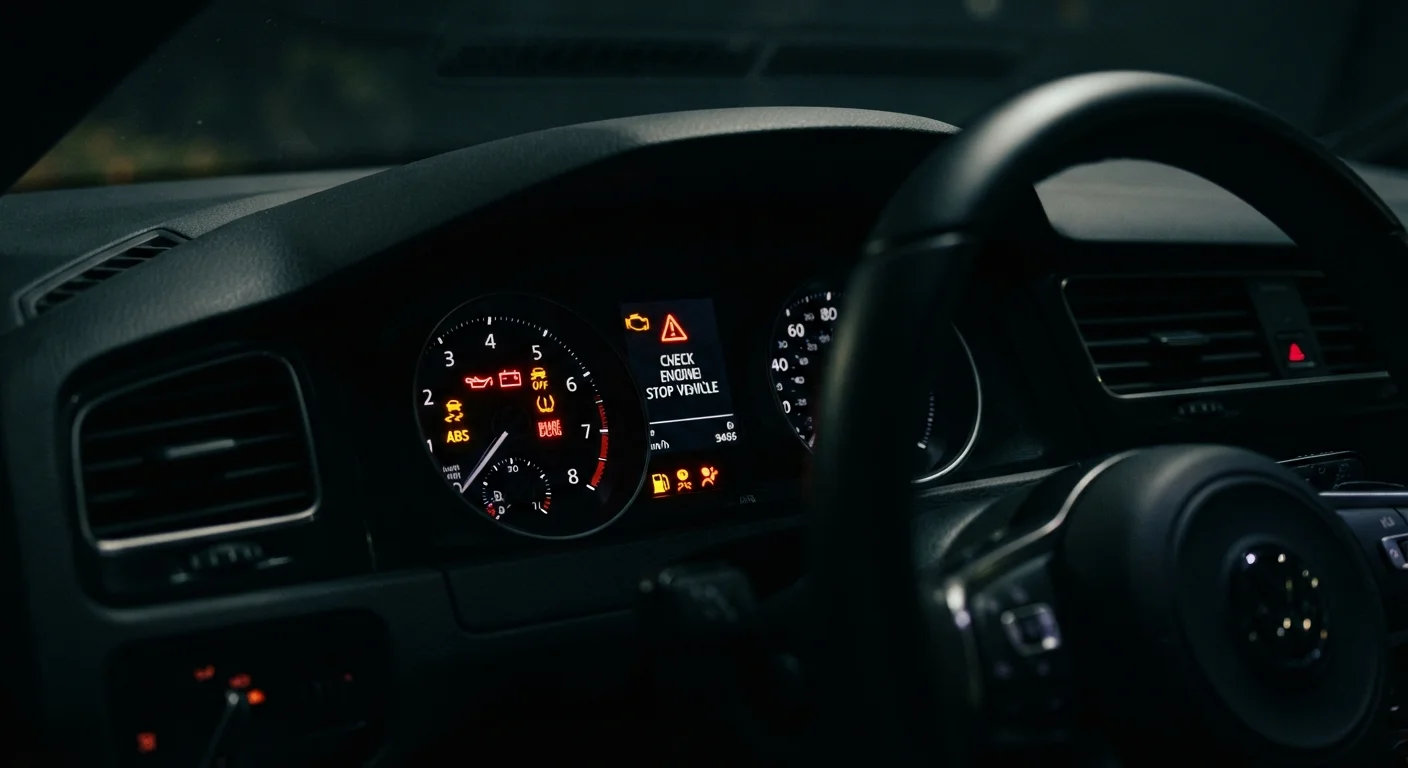
Photo: InsightsTurbo.com | Kickstart Your Knowledge Quest editorial
Why Warning Lights Exist and What They're Telling You
Your car's dashboard is a communication system. Every warning light is a signal from your vehicle's onboard diagnostics - a network of sensors that monitors engine performance, fluid levels, safety systems, and more. Ignoring a light doesn't make the problem go away; it typically makes it worse and more expensive to fix.
Warning lights generally fall into three color categories:
- Red: Urgent. Stop driving or take immediate action.
- Amber/Yellow: Attention needed soon - schedule a check within days, not weeks.
- Green/Blue: Informational - a system is active (high beams, turn signal, etc.).
New owners frequently overlook amber lights, assuming they're minor. That assumption is one of the early mistakes that cost new car owners the most. A persistent amber light left unaddressed can escalate into a red-light emergency - and a much larger repair bill.
| Colors of warning lights | Red (urgent), Amber (attention needed), Green/Blue (informational) |
| OBD-II standard required since | 1996 (all US passenger vehicles) (US EPA / CARB mandate) |
| TPMS required on US vehicles since | 2008 (NHTSA TPMS rule) |
| Most common amber light | Check Engine (covers dozens of fault codes) |
| Recommended response to red light | Pull over and stop engine as soon as safely possible |
| Tire pressure reference location | Driver's door jamb sticker - not the tire sidewall |
Common Warning Lights and What They Signal
The following are the most frequently encountered dashboard symbols in US-market vehicles. Your owner's manual is always the definitive reference for your specific make and model.
OBD-II / Diagnostic Scanner
A standardized port found in all US vehicles made after 1996 that allows mechanics (or handheld consumer tools) to read fault codes stored by the car's computer. This is how the specific cause behind a Check Engine light is identified.
TPMS
Tire Pressure Monitoring System. A sensor network that tracks air pressure in each tire and triggers a dashboard warning when pressure drops below a safe threshold. Required on all US passenger vehicles manufactured after 2008.
Coolant / Antifreeze
The fluid that circulates through your engine and radiator to regulate operating temperature. Low coolant levels can cause rapid overheating. It is checked at the translucent reservoir under the hood, not the radiator cap.
Catalytic Converter
An emissions control device in your exhaust system that converts harmful gases into less toxic compounds. A failing catalytic converter often triggers the Check Engine light and can reduce fuel efficiency.
Traction Control System (TCS)
An active safety system that reduces wheel spin during acceleration on slippery surfaces by reducing engine power or applying selective braking. Shares sensors with the Electronic Stability Control (ESC) system.
Red Lights: Stop or Act Immediately
- Oil Pressure Warning (oil can icon)
- Oil pressure has dropped dangerously low. Pull over safely and turn off the engine. Driving with low oil pressure can destroy your engine within minutes.
- Engine Temperature Warning (thermometer in liquid)
- Your engine is overheating. Stop as soon as safely possible, turn off the engine, and let it cool before checking coolant levels. Do not open the radiator cap while hot.
- Battery / Charging System (battery icon)
- The electrical system isn't charging properly. You may have limited time before the car loses power. Drive directly to a service facility or pull over before the engine stalls.
- Brake Warning Light (exclamation mark in circle)
- Could indicate the parking brake is engaged, low brake fluid, or a brake system fault. If the parking brake is off and the light stays on, have brakes inspected immediately.
Amber Lights: Schedule Service Soon
- Check Engine (engine outline)
- A broad signal covering dozens of possible fault codes - from a loose gas cap to a failing catalytic converter. A mechanic can read the specific code with a diagnostic scanner.
- Tire Pressure (TPMS - exclamation in flat tire)
- One or more tires are significantly under- or over-inflated. Check pressure at a gas station and inflate to the level listed on your driver's door jamb sticker, not the tire sidewall.
- Traction Control / Stability System (car with wavy lines)
- Flashing during a skid is normal - the system is working. Staying on solid means the system has been disabled or has a fault. Relevant to driving in adverse conditions where traction matters most.
- Transmission Temperature (thermometer with gear)
- Transmission fluid is overheating. Ease off towing or steep grades and allow the vehicle to cool.
Your Owner's Manual Is the Authority
What to Do When a Light Comes On
The right response depends on the light's color and whether you notice any accompanying symptoms (unusual sounds, vibrations, smoke, or loss of power).
- Red light or physical symptoms: Signal, pull over safely, and turn off the engine. Do not continue driving unless you are in an unsafe location (e.g., a highway lane with no shoulder). Call for roadside assistance.
- Amber light, no symptoms: Note when it appeared and book a diagnostic appointment within a few days. Avoid long highway trips until the issue is identified.
- Light turns off on its own: Don't assume the problem resolved. Intermittent lights often point to developing faults. Have the car scanned anyway.
- Multiple lights at once: A cluster of lights illuminating simultaneously often points to a battery or alternator issue rather than multiple separate faults.
Developing the habit of glancing at your instrument cluster at the start of each drive takes seconds and can catch problems before they become roadside emergencies - the same attentiveness that supports good driving habits overall.
The content provided on our blog site traverses numerous categories, offering readers valuable and practical information. Readers can use the editorial team’s research and data to gain more insights into their topics of interest. However, they are requested not to treat the articles as conclusive. The website team cannot be held responsible for differences in data or inaccuracies found across other platforms. Please also note that the site might also miss out on various schemes and offers available that the readers may find more beneficial than the ones we cover.