
Road Signs, Markings, and Lane Rules: A Driver's Quick Reference

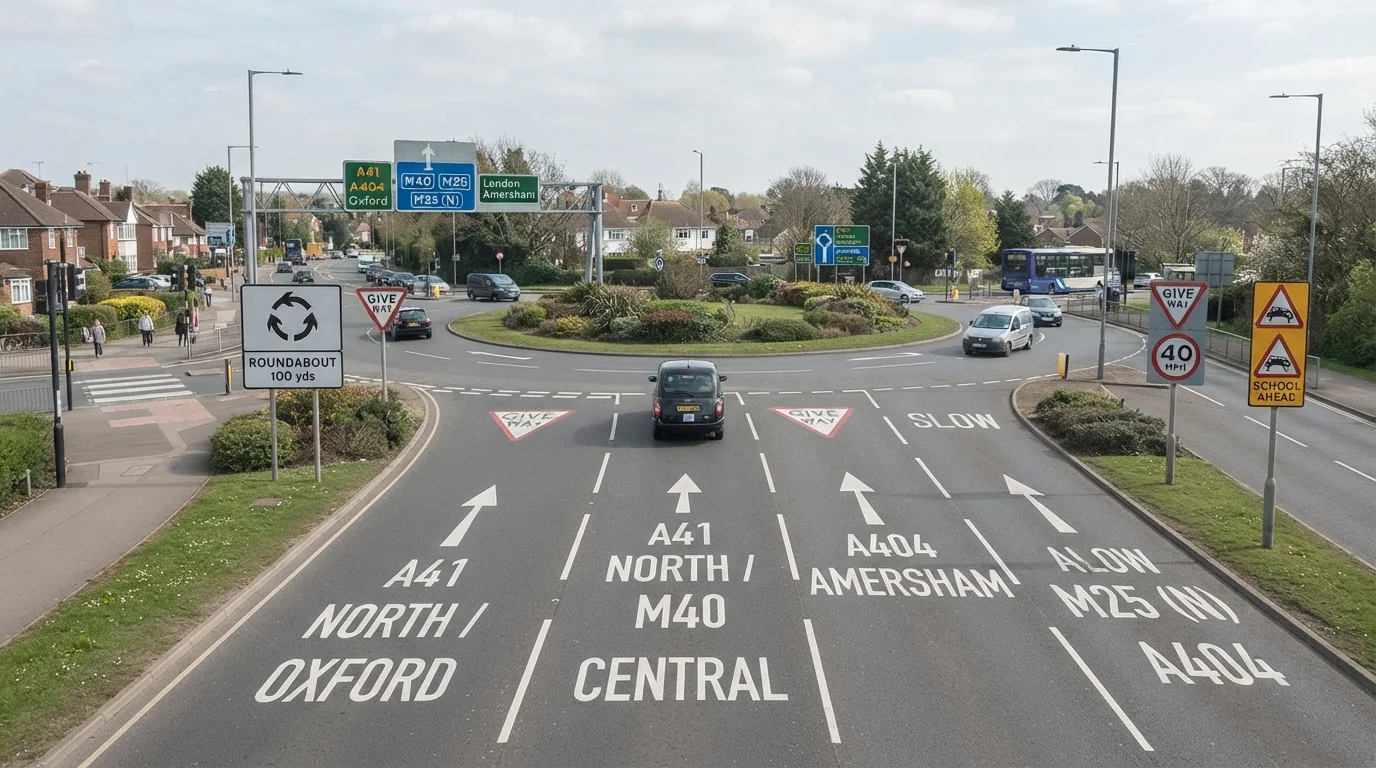
Photo: InsightsTurbo.com | Kickstart Your Knowledge Quest editorial
Road Signs at a Glance
UK road signs follow a consistent shape and colour system set by the Highway Code. Once you understand the logic, you can read unfamiliar signs almost instinctively.
| Sign shape: circle | Orders (red = prohibit, blue = instruct) (UK Highway Code) |
| Sign shape: triangle | Warning - hazard ahead (UK Highway Code) |
| Sign shape: rectangle | Information and direction (UK Highway Code) |
| Temporary signs | Yellow background; override permanent signs (UK Highway Code) |
| Double yellow lines | No parking at any time (UK Highway Code Rule 238) |
| Middle-lane hogging | Offence under Highway Code Rule 264 (UK Highway Code) |
- Circles give orders. Red circles prohibit - a red ring around a number sets a speed limit; a red ring around a symbol bans an action (e.g., no entry, no overtaking). Blue circles give positive instructions, such as keep left or use a roundabout lane.
- Triangles warn. Red triangular signs alert you to a hazard ahead - junction, pedestrians, sharp bend. They require you to anticipate, not necessarily stop.
- Rectangles inform. These carry direction, distance, or route information. Blue backgrounds indicate motorways; green indicates primary roads; white indicates local routes.
Temporary signs on yellow backgrounds override permanent signs - slow down and pay close attention when you see them near roadworks.
Road Markings Decoded
Markings painted on the road surface carry legal weight just like upright signs. Ignoring them can result in a fixed penalty or prosecution.
Carriageway
The part of the road intended for vehicle traffic, excluding pavements and cycle lanes. A dual carriageway has two separate carriageways divided by a central reservation.
Hazard warning line
A road marking with longer dashes and shorter gaps than a standard centre line, indicating a hazard such as a junction or sharp bend is approaching.
Box junction
A yellow criss-cross marking at a junction that prohibits vehicles from entering unless their exit road is clear, preventing gridlock.
Lane discipline
The practice of using the correct lane for your speed and direction of travel, particularly keeping left except when overtaking on multi-lane roads.
Blind spot
The area around a vehicle not visible in any mirror. Drivers must physically turn their head to check the blind spot before changing lanes.
Line Types
- Single broken white line (centre line): Separates traffic travelling in opposite directions. You may cross it to overtake when it is safe to do so.
- Double white lines: If the line nearest to you is solid, you must not cross or straddle it except in specific circumstances (turning into a property, passing a stationary obstruction, or obeying a police officer). If the nearest line is broken, you may cross only if it is safe and you can complete the manoeuvre before reaching a solid line.
- Hazard warning lines: Longer dashes with shorter gaps - a sign to expect a hazard ahead such as a junction or bend. Do not overtake if in any doubt.
- Yellow lines (edge of carriageway): Single yellow means parking restrictions apply at certain times (check nearby signs for hours). Double yellow means no parking at any time.
- Box junctions: Yellow criss-cross markings. You must not enter unless your exit is clear - with one exception: you may enter to turn right if you are only prevented from doing so by oncoming traffic.
Arrow markings in lanes tell you which direction you must take from that lane. Follow them even if your sat-nav suggests otherwise - changing lanes at the last moment causes rear-end collisions and is a common new-driver error. See our guide to junctions and roundabouts for how these arrows work at complex junctions.
Lane Discipline Rules Every Driver Must Know
Poor lane discipline is one of the most cited causes of motorway and dual-carriageway incidents. The principle in UK law is straightforward: keep left unless overtaking.
Middle-Lane Driving Is a Penalisable Offence
On Multi-Lane Roads
- The left lane is the normal driving lane on any dual carriageway or motorway. Return to it as soon as you have completed an overtake.
- The middle lane of a three-lane motorway is for overtaking slower vehicles in the left lane only. Staying in the middle lane unnecessarily is an offence under the Highway Code (Rule 264) and can attract a fixed penalty.
- The right lane is for overtaking only - never use it as a default cruising lane.
Lane Changes
- Check your mirrors - centre, then the mirror on the side you intend to move.
- Signal in good time to inform other road users of your intention.
- Check the blind spot with a shoulder glance.
- Move smoothly only when the gap is clearly safe.
Before any drive, completing your pre-drive vehicle checks - including mirrors - ensures your visibility is not compromised before you reach the road. For a full introduction to lane rules at higher speeds, see our motorway driving guide.
The content provided on our blog site traverses numerous categories, offering readers valuable and practical information. Readers can use the editorial team’s research and data to gain more insights into their topics of interest. However, they are requested not to treat the articles as conclusive. The website team cannot be held responsible for differences in data or inaccuracies found across other platforms. Please also note that the site might also miss out on various schemes and offers available that the readers may find more beneficial than the ones we cover.