
Four-Year University vs. Two-Year College: The Real Differences

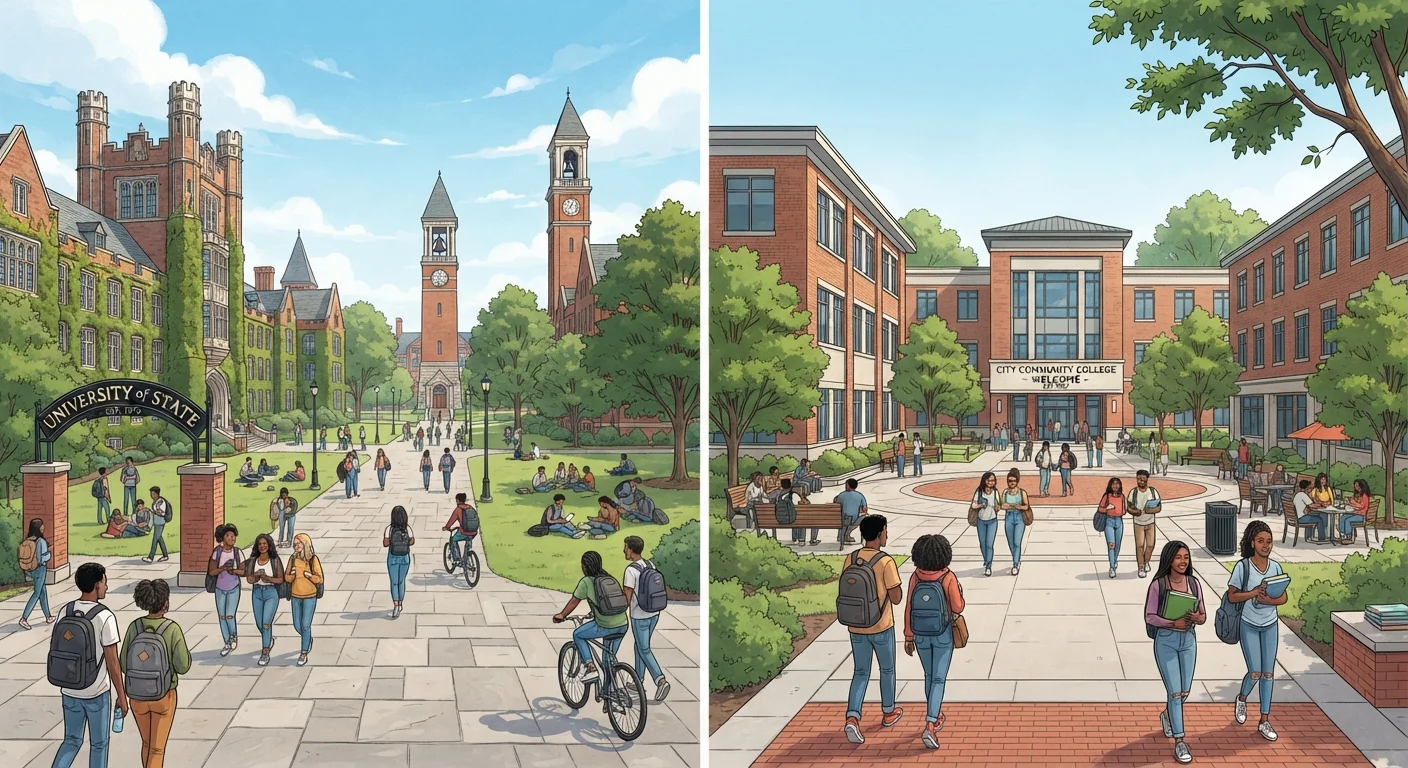
Photo: InsightsTurbo.com | Kickstart Your Knowledge Quest editorial
Key Takeaways
- Four-year universities typically cost two to three times more annually than two-year community colleges.
- Two-year colleges grant associate degrees and certificates; four-year universities grant bachelor's degrees.
- Many community college credits transfer to four-year universities, enabling a lower-cost path to a bachelor's degree.
- Career outcome differences vary widely by field - some jobs require a bachelor's degree by default.
- Flexibility and schedule options are generally broader at two-year colleges, which often serve working adults.
- Neither path is universally superior - the right choice depends on your career goals, finances, and timeline.
Cost and Debt: What You'll Actually Pay
Cost is often the sharpest difference between these two paths. According to the College Board's annual survey data, average published tuition and fees at public four-year universities run significantly higher than at public two-year colleges - sometimes two to three times as much per year before room and board are added. Private four-year universities widen that gap further.
Two-year community colleges have historically kept tuition lower as part of their public-access mission. Some states have introduced free community college programs for qualifying residents, reducing upfront costs even further.
However, sticker price isn't the whole story. Financial aid, scholarships, and institutional grants can dramatically alter what any individual student pays. The net price - what you actually owe after aid - is the number worth researching for any school you're considering. See key questions to ask before committing to any program to know exactly what to request from an admissions office.
~$3,800
Avg. annual tuition at public two-year colleges
Based on College Board Trends in College Pricing survey data for in-district tuition and fees.
~$11,260
Avg. annual tuition at public four-year universities
College Board data reflects in-state tuition and fees; out-of-state and private costs are substantially higher.
31%
Of bachelor's degree students start at community college
National Student Clearinghouse Research Center data highlights the prevalence of the transfer pathway.
Credentials and Curriculum: What You'll Earn
The credential you graduate with shapes how employers and graduate programs read your résumé. Four-year universities award bachelor's degrees (B.A., B.S., and similar), which typically require around 120 credit hours spread across general education requirements, a declared major, and elective coursework. The broader curriculum is intentional - it exposes students to multiple disciplines before they specialize.
Two-year colleges award associate degrees (A.A., A.S., A.A.S.) and shorter-term certificates. An Associate of Arts or Associate of Science is designed to transfer into the junior year of a four-year program, assuming the student's credits are accepted by the receiving institution. An Associate of Applied Science is often terminal - built for direct workforce entry rather than transfer.
Understanding which type of associate degree a program offers matters enormously. If transferring is your goal, confirm that your intended four-year school has a formal articulation agreement with the community college before you enroll.
| Criterion | Four-Year University | Two-Year College |
|---|---|---|
| Credential awarded | Bachelor's degree | Associate degree or certificate |
| Typical duration | 4 years (full-time) | 2 years (full-time) |
| Average annual tuition (public) | Higher - roughly $10,000-$12,000+ | Lower - roughly $3,000-$4,500 |
| Schedule flexibility | Moderate; daytime-heavy | High; evening, online, hybrid |
| Campus residential life | Common; housing available | Rare; mostly commuter |
| Transfer pathways | Not applicable | Yes, with articulation agreements |
| Graduate school eligibility | Direct pathway | Requires bachelor's first |
| Student population diversity | Mostly traditional-age students | Wide age range; many working adults |
Flexibility, Campus Life, and Student Support
Four-year universities tend to offer richer on-campus ecosystems: residential housing, athletic programs, research labs, career centers, and a wide range of student organizations. For students who thrive in immersive environments, this infrastructure can be genuinely valuable. It also comes at a cost - room and board at a four-year school can rival or exceed tuition itself.
Community colleges serve a broader range of students, including adults returning to school while working or raising families. As a result, course schedules are typically more flexible, with more evening, hybrid, and fully online options. Class sizes at community colleges are often smaller for introductory courses, and instructors tend to be practitioners in their fields rather than research-focused faculty.
For a deeper look at how community college is structured day-to-day, see what a community college education actually looks like.
Accreditation Is Non-Negotiable
Career Outcomes: Does the Degree Level Matter?
The relationship between degree level and earnings is real but nuanced. Bureau of Labor Statistics data consistently shows that median weekly earnings rise with credential level - bachelor's degree holders, on average, out-earn associate degree holders. But averages obscure wide variation by field.
In skilled trades, healthcare technology, and certain IT roles, an associate degree or certificate can open well-paying jobs without the added time or cost of a four-year program. In contrast, fields like accounting, engineering, and most K-12 teaching roles set a bachelor's degree as the functional minimum for entry.
The transfer route - starting at a two-year college and finishing a bachelor's at a four-year university - is a well-established strategy that can yield comparable career outcomes to entering a four-year school directly, provided the transfer is planned carefully. If you're still weighing multiple education formats altogether, mapping your options across college, trade school, and self-directed learning offers a broader framework to orient your thinking.
The content provided on our blog site traverses numerous categories, offering readers valuable and practical information. Readers can use the editorial team’s research and data to gain more insights into their topics of interest. However, they are requested not to treat the articles as conclusive. The website team cannot be held responsible for differences in data or inaccuracies found across other platforms. Please also note that the site might also miss out on various schemes and offers available that the readers may find more beneficial than the ones we cover.