
Fixed vs. Variable Expenses: Why the Distinction Matters

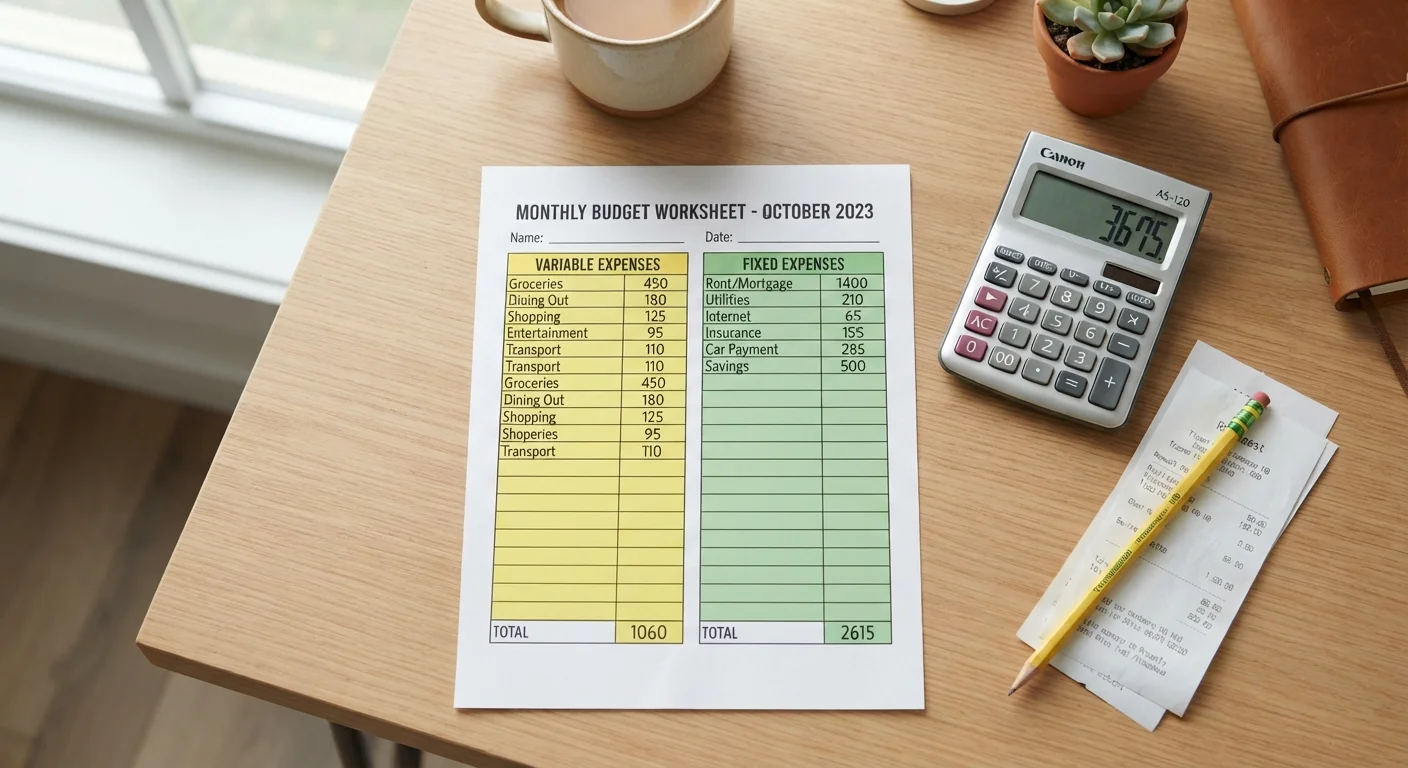
Photo: InsightsTurbo.com | Kickstart Your Knowledge Quest editorial
Key Takeaways
- Fixed expenses stay the same each month; variable expenses change based on usage or choices.
- Knowing your fixed costs tells you the minimum income needed to cover your obligations.
- Variable expenses are where most budgeting adjustments and savings opportunities live.
- Some expenses are semi-variable — partly fixed, partly usage-based — and deserve special attention.
- Mapping both categories before choosing a budgeting method leads to more realistic spending plans.
What Makes an Expense Fixed or Variable?
Every dollar you spend falls into one of two broad camps: fixed expenses are costs that remain the same from month to month regardless of what you do, while variable expenses shift in size depending on your behaviour, usage, or circumstances.
Rent or a mortgage payment is the classic fixed expense — the same amount hits your account on the same date every month. A utility bill, by contrast, is variable: use more electricity in summer and the bill climbs; use less and it drops. Understanding which category an expense belongs to isn't just an academic exercise — it shapes how you approach planning, cutting, and saving. See our guide to spending categories for a practical look at how to group these costs meaningfully.
It's also worth noting a middle category: semi-variable expenses (sometimes called mixed costs). Your phone plan might have a fixed base charge plus variable overage fees. Your gym membership is fixed, but any personal training sessions you add are variable. Recognising these hybrid costs helps you budget them more accurately.
Fixed vs. Variable: A Side-by-Side Look
The table below contrasts both expense types across the criteria that matter most when you're building a budget.
| Criterion | Fixed Expenses | Variable Expenses |
|---|---|---|
| Amount each month | Stays the same | Changes with usage or choices |
| Common examples | Rent, loan payments, insurance | Groceries, dining out, fuel |
| Predictability | High — easy to plan around | Lower — requires tracking |
| Room to cut short-term | Limited without major lifestyle change | Often significant with habit shifts |
| Budget role | Sets your minimum income floor | Primary area for spending adjustments |
| Impact of income drop | Obligations remain; risk of shortfall | Can reduce spending to compensate |
Notice that neither type is inherently better or worse — they play different roles. Fixed expenses give your budget a predictable skeleton; variable expenses provide the flexibility that lets you adapt month to month.
Why the Distinction Changes How You Budget
When you sit down to build a spending plan, the first number you need is your fixed expense total. This is your floor — the minimum amount of income you must bring in before you have a single dollar of discretionary room. If your fixed costs total $1,800 a month and you earn $2,400, you have $600 to allocate across everything else.
~33%
Average share of income spent on housing alone
U.S. Bureau of Labor Statistics Consumer Expenditure data consistently shows housing as the largest single fixed expense category for most households.
~15%
Typical share of spending on food (variable)
BLS Consumer Expenditure surveys show food — a largely variable cost — represents roughly 12–15% of average household spending, with wide variation by income level.
Variable expenses, by contrast, are where real budgeting decisions happen. Because they fluctuate, they respond to choices: cooking at home instead of dining out, carpooling instead of driving alone, cancelling a streaming service you rarely use. Most people find their biggest savings opportunities concentrated here.
This distinction is especially important if you earn an irregular income. During a lower-earning month, your fixed obligations don't shrink — so knowing exactly what they are helps you prioritise. For a deeper look at managing this challenge, see our article on budgeting on an irregular income.
Once you understand both categories, you're better positioned to choose a budgeting method that fits your life. Our budgeting methods comparison walks through several common frameworks and how they treat fixed versus variable spending differently.
When a Fixed Expense Can Become Variable
This article is for general informational and educational purposes only and does not constitute personalised financial advice. Consider consulting a qualified financial professional for guidance specific to your situation.
The content provided on our blog site traverses numerous categories, offering readers valuable and practical information. Readers can use the editorial team’s research and data to gain more insights into their topics of interest. However, they are requested not to treat the articles as conclusive. The website team cannot be held responsible for differences in data or inaccuracies found across other platforms. Please also note that the site might also miss out on various schemes and offers available that the readers may find more beneficial than the ones we cover.