
Night Driving vs. Daytime Driving: What Changes and What Doesn't

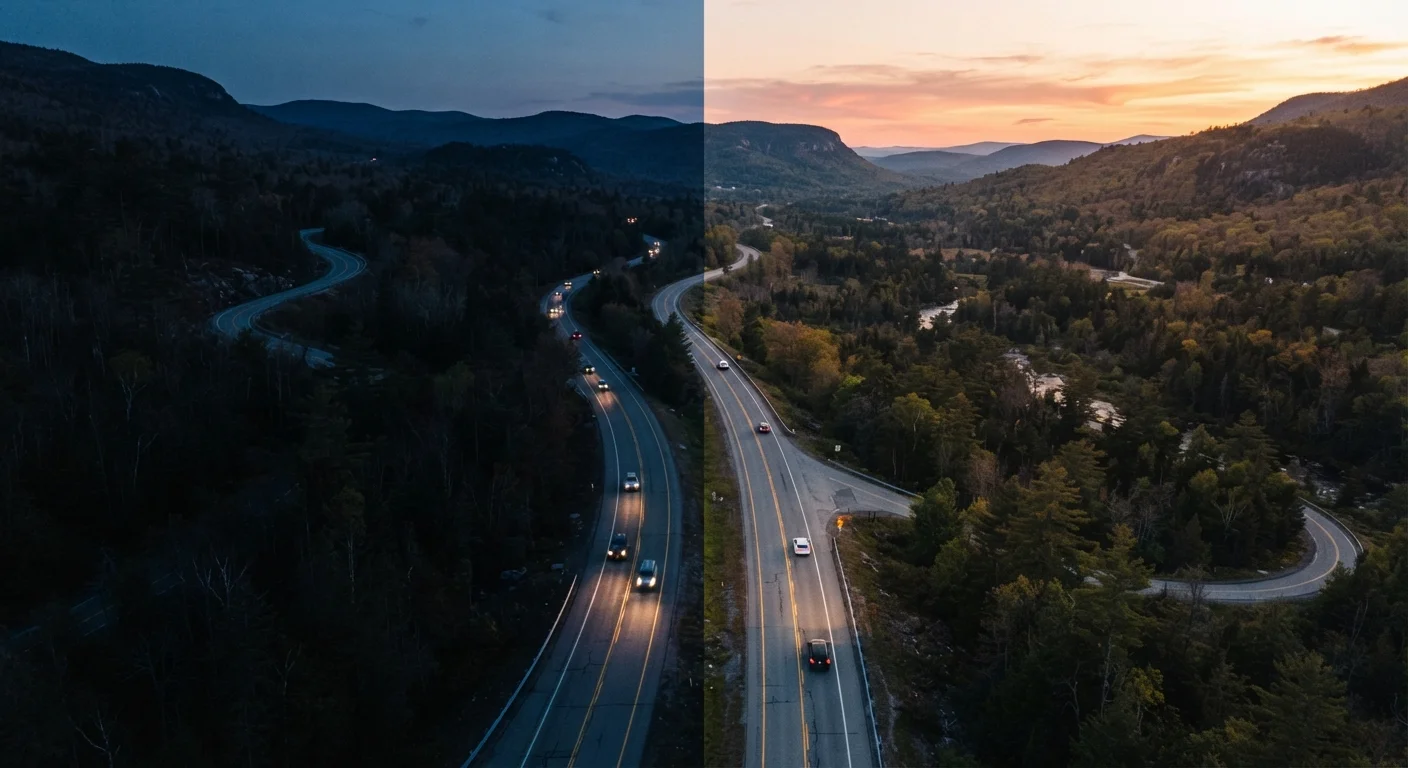
Photo: InsightsTurbo.com | Kickstart Your Knowledge Quest editorial
Key Takeaways
- Headlights typically illuminate only 200-250 feet ahead, so high-speed night driving outruns your ability to stop safely.
- Driver fatigue peaks between midnight and 6 a.m., making late-night trips significantly riskier than afternoon drives.
- Pedestrians, cyclists, and animals are far harder to spot at night - scanning technique must be more deliberate.
- High-beam etiquette matters: misuse blinds oncoming drivers and creates its own hazards.
- Core defensive-driving principles - space management, smooth inputs, hazard anticipation - apply equally day and night.
Why Night Driving Is a Different Discipline
Most new drivers log the majority of their practice hours in daylight. That's understandable - daytime offers natural light, easier depth perception, and a more forgiving environment for building muscle memory. But roughly half of all traffic fatalities in the US occur at night, even though nighttime accounts for far less total driving. That disparity isn't a coincidence.
After dark, your visual field shrinks dramatically. Your eyes shift from sharp cone-based (color, detail) vision to rod-based (low-light, peripheral) vision, which sacrifices acuity. Your ability to judge distances and spot hazards at the edge of the road degrades - and no amount of experience fully compensates for the physics of limited light. What changes is how you compensate for that limitation.
Understanding the contrast between day and night conditions is the first step toward driving confidently in both.
| Criterion | Daytime Driving | Night Driving |
|---|---|---|
| Visibility range | Natural light; broad, clear field | Limited to headlight beam (~200 ft low) |
| Primary hazard types | Traffic volume, distracted drivers | Pedestrians, animals, impaired drivers |
| Fatigue risk | Lower during typical daytime hours | High, especially midnight-6 a.m. |
| Depth perception | Full binocular cues available | Reduced; distances harder to judge |
| Glare from other vehicles | Minimal | Significant; can cause temporary blindness |
| Recommended following distance | Minimum 3 seconds | 4+ seconds advised |
| Vehicle condition impact | Dirty lights are inconvenient | Dirty lights are a genuine hazard |
What Changes After Dark
Visibility range and headlight limits. Standard low-beam headlights illuminate roughly 200 feet ahead. At 60 mph, your vehicle covers that distance in about 2.3 seconds - less time than a typical hazard-recognition-and-braking sequence requires. This is called overdriving your headlights, and it's one of the most common night-driving errors. Reducing speed after dark isn't timidity; it's math.
Hazard types shift. Pedestrians, cyclists, and animals dominate the night-hazard profile in ways that differ from daytime. A deer crossing an unlit rural road at 11 p.m. gives you almost no warning. Pedestrians wearing dark clothing may appear only feet from your vehicle. Scan the full width of your headlight beam, not just the center lane ahead. Our guide on urban vs. rural road hazards covers how these risks concentrate differently by environment.
Fatigue becomes a serious co-factor. The body's circadian rhythm suppresses alertness between midnight and 6 a.m. Driving in that window - especially after a long day - compounds every other night-driving risk. Reaction time slows, lane discipline erodes, and microsleeps (brief unconscious lapses) become possible. See our in-depth look at driver fatigue as a road hazard for the warning signs and when to pull over.
Glare from oncoming traffic. High beams from an approaching vehicle can temporarily blind you - the effect lasts several seconds even after the light passes. The correct response is to drop your gaze to the right edge of the lane rather than staring into the light, and to avoid retaliating with your own high beams.
~50%
Nighttime share of US traffic fatalities
According to the National Safety Council, roughly half of all traffic deaths occur at night despite significantly lower traffic volumes after dark.
200 ft
Typical low-beam headlight range
The AAA Foundation for Traffic Safety notes standard low beams illuminate approximately 160-200 feet - often less than the distance needed to stop at highway speeds.
3x
Higher fatality rate per mile at night
The National Highway Traffic Safety Administration (NHTSA) has reported that the nighttime fatality rate per mile driven is approximately three times the daytime rate.
What Stays Exactly the Same
It's easy to treat night driving as an entirely separate activity, but the foundation of safe driving doesn't change when the sun sets.
Following distance rules still apply - and then some. The standard three-second following gap is a minimum under ideal daytime conditions. At night, extend it. Reduced visibility means you need more time to identify and respond to brake lights ahead. Our article on stopping distances and speed explains why this buffer matters more than most drivers realize.
Aggressive habits remain dangerous. Tailgating and speeding are high-risk behaviors in daylight - at night, their consequences scale up sharply. A driver who tailgates in the daytime and survives it is borrowing against margins that simply don't exist after dark. The risks of tailgating and speeding are covered in detail in our safety habits guide.
Smooth, predictable inputs matter. Sudden braking, sharp steering, and erratic lane changes create risk regardless of lighting conditions. Other drivers can read your intentions through your movements - telegraphing turns and stops clearly remains essential.
Vehicle checks don't change, but their stakes rise. A cracked or dirty windshield causes mild glare in daylight. At night with oncoming headlights, it can scatter light badly enough to impair your view entirely. Burned-out tail lights or foggy headlight lenses - problems you might tolerate during the day - become genuine hazards after dark.
Night Driving and Adverse Weather Overlap
Practical Adjustments for Night Driving
A few specific habits close the gap between daytime confidence and nighttime competence:
- Use high beams strategically. On unlit roads with no oncoming traffic, high beams extend your range to around 350-400 feet - a meaningful safety improvement. Switch back to low beams when an oncoming vehicle appears or when following closely behind another car.
- Clean your lights and windshield regularly. Dirty lenses and streaky glass are cheap problems with disproportionately large safety consequences at night.
- Lower your dash brightness. Bright instrument lighting creates a contrast that makes it harder for your eyes to adapt to the dark road ahead. Most vehicles allow you to dim the cluster display.
- Plan rest stops on long trips. If you're driving past midnight, build in at least one stop regardless of how alert you feel. Fatigue is often self-concealing - drivers frequently underestimate how impaired they are.
- Slow down on unfamiliar roads. Roads you know well in daylight can feel disorienting at night. Give yourself more time to read signs, judge curves, and react to unmarked hazards.
Night driving rewards preparation and penalizes overconfidence. The drivers who handle it best aren't those with the sharpest eyes - they're the ones who understand their limitations and build in the margins to compensate.
The content provided on our blog site traverses numerous categories, offering readers valuable and practical information. Readers can use the editorial team’s research and data to gain more insights into their topics of interest. However, they are requested not to treat the articles as conclusive. The website team cannot be held responsible for differences in data or inaccuracies found across other platforms. Please also note that the site might also miss out on various schemes and offers available that the readers may find more beneficial than the ones we cover.