
The Lighting Decisions That Change How Every Room Feels

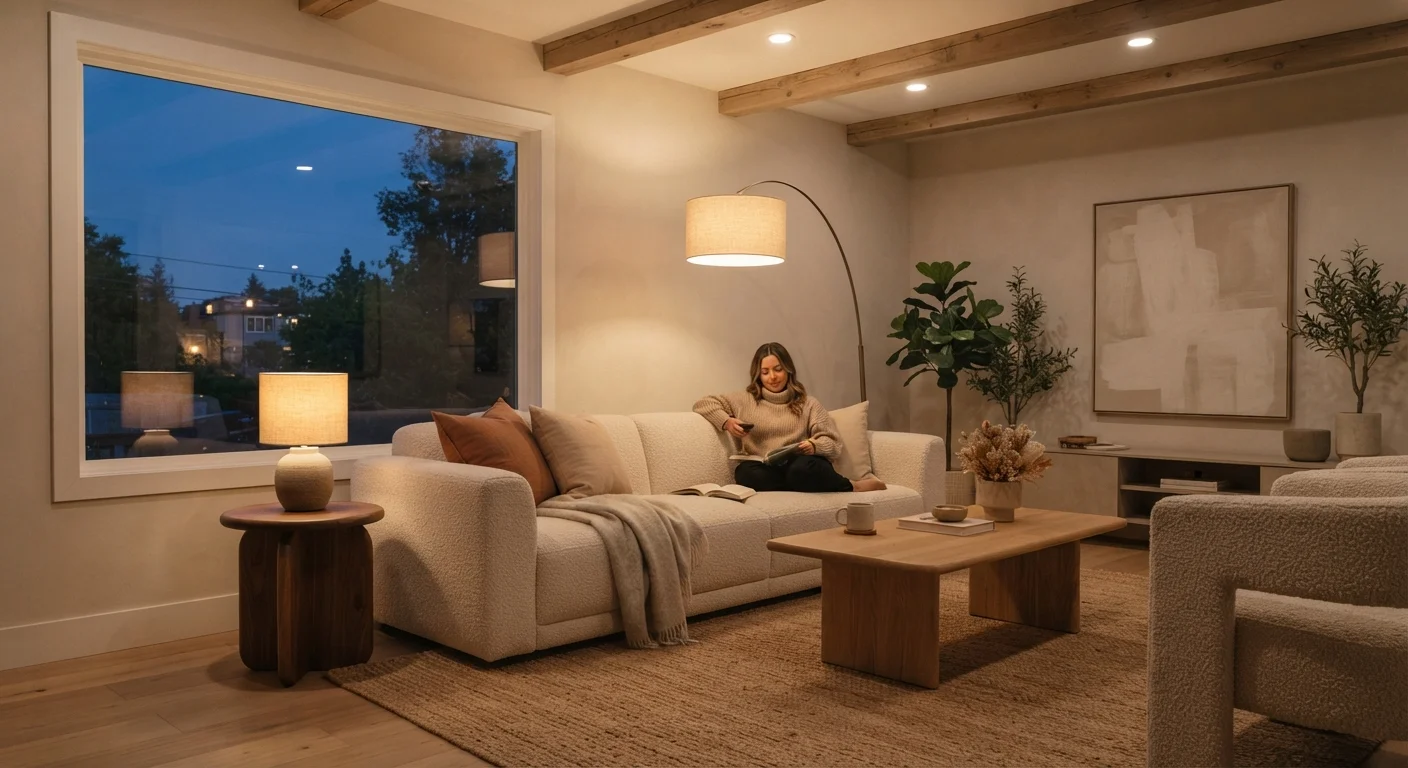
Photo: InsightsTurbo.com | Kickstart Your Knowledge Quest editorial
Key Takeaways
- Rooms feel more liveable when ambient, task, and accent lighting work together rather than relying on a single overhead source.
- Color temperature, measured in Kelvin, determines how warm or cool light appears - 2,700K-3,000K reads as warm; 4,000K and above reads as cool and crisp.
- Adding floor lamps, table lamps, and smart bulbs is a renter-friendly way to layer light without touching any fixtures.
- Using the same Kelvin value across all bulbs in a room creates visual consistency for minimal cost.
- Before changing dimmer switches or light fixtures in a rental, always check your lease for what alterations are permitted.
The Three Types of Light Every Room Needs
Every well-lit room draws from three distinct lighting layers - ambient, task, and accent. Understanding how they work together is the most practical thing you can learn about interior lighting.
Ambient lighting
This is your room's baseline - the general illumination that fills the whole space. Overhead fixtures, ceiling-mounted lights, and recessed lighting typically provide it. Alone, it tends to feel flat.
Task lighting
Task lighting is directed and purposeful, aimed at a specific activity: reading, cooking, or working at a desk. Table lamps, under-cabinet strips, and adjustable desk lamps all serve this function.
Accent lighting
Accent lighting adds visual depth - wall sconces, picture lights, or small spotlights that draw attention to a shelf, a plant, or artwork. It's the layer most people skip, and the one that most separates a room that looks "set up" from one that actually feels considered. Lighting also interacts with other surfaces; our guide to paint finish types covers how sheen levels affect the way light behaves on your walls.
~15%
Share of US home electricity used for lighting
According to the U.S. Department of Energy, lighting accounts for roughly 15% of a typical US household's electricity use.
75%+
Energy savings: LED vs. incandescent bulbs
The U.S. Department of Energy reports that LED bulbs use at least 75% less energy than traditional incandescent bulbs and last significantly longer.
Color Temperature: The Detail That Changes Everything
The color of light - how warm or cool it appears - is measured in Kelvin (K). Lower numbers (around 2,700K-3,000K) produce warm, amber-toned light most people associate with comfort and evening relaxation. Higher numbers (4,000K and above) produce cooler, bluer light that supports alertness and focus.
A practical approach: use warm-toned bulbs in living rooms and bedrooms, and slightly cooler options (around 3,000K-3,500K) in kitchens and bathrooms where clarity matters more. Mixing color temperatures in the same room without intention creates visual inconsistency - swapping all bulbs in a space to the same Kelvin value is a simple, low-cost improvement that makes an immediate difference.
If you're thinking about how lighting interacts with the overall feel of a room, our guide on making a small room feel larger covers how light direction and intensity also affect perceived space.
Layering Light Without Starting From Scratch
Most rentals and starter homes come with one overhead fixture per room - which is almost always insufficient on its own. The goal isn't to replace what's there, but to supplement it strategically.
Start by identifying where your current light falls short: harsh glare at night, a dark reading corner, or a room that feels cold and unwelcoming. Then work from surfaces upward. A floor lamp in a dim corner, a table lamp beside the couch, a clip-on reading light at the bed - each addition gives you more control over how the room functions at different times of day.
Dimmer switches can let a single fixture serve multiple moods. If your lease permits alterations, a dimmer is one of the most cost-effective changes you can make. If rewiring isn't an option, a smart bulb with a dimming app achieves similar results in any standard socket. Before making any changes to fixtures or switches, check what your lease allows - our article on understanding your lease is a useful starting point.
Start With What You Already Have
Room-by-Room Lighting Priorities
A few practical priorities by room:
- Kitchen: Task lighting above work surfaces matters most. Under-cabinet strips or pendant lights over an island reduce the shadows that make prep work frustrating.
- Living room: Layering is everything. A floor lamp, a table lamp, and dimmable overhead lighting together create flexibility for movie nights, conversation, and reading.
- Bedroom: Warm, dimmable light supports winding down. Bedside table lamps or wall-mounted reading lights reduce your dependence on bright overhead fixtures at night.
- Bathroom: Combine overhead lighting with side-lit vanity lighting. Light positioned at the sides of a mirror minimizes facial shadows better than a single source directly above.
Lighting works in context - it interacts with room size, layout, and furniture placement. If you're still working through the basics of a new space, measuring your room accurately is a practical first step before making any changes.
Frequently Asked Questions
The content provided on our blog site traverses numerous categories, offering readers valuable and practical information. Readers can use the editorial team’s research and data to gain more insights into their topics of interest. However, they are requested not to treat the articles as conclusive. The website team cannot be held responsible for differences in data or inaccuracies found across other platforms. Please also note that the site might also miss out on various schemes and offers available that the readers may find more beneficial than the ones we cover.