
Why High-Interest Debt Should Usually Come Before Long-Term Savings

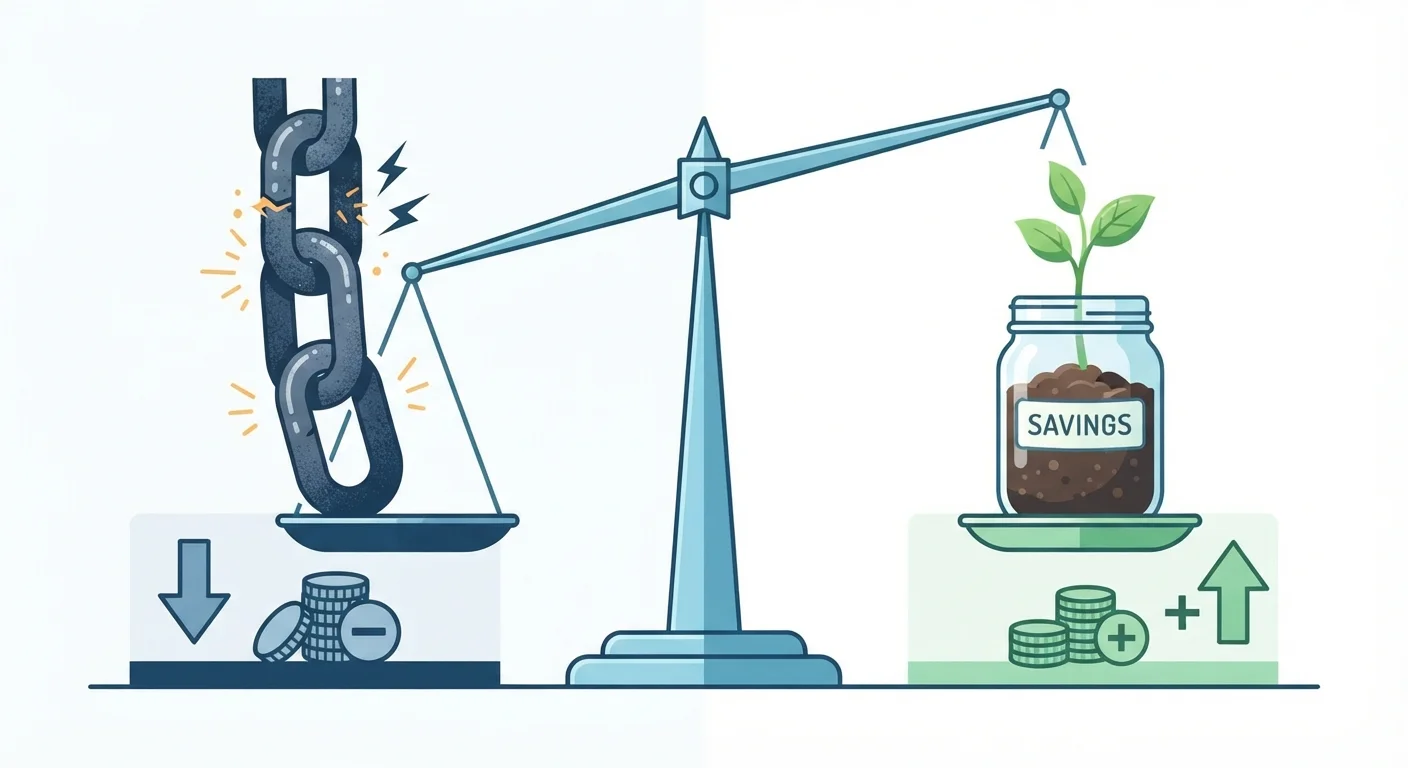
Photo: InsightsTurbo.com | Kickstart Your Knowledge Quest editorial
Key Takeaways
- High-interest debt — typically credit cards — often charges rates far above what savings accounts or market investments reliably return.
- Paying 20% interest on debt while earning 4–5% in savings results in a net loss on every dollar split between the two.
- A small emergency fund should be established first before aggressively tackling debt, to avoid new borrowing for surprise expenses.
- Low-interest debt, such as some student loans, may not warrant the same urgency and requires a different trade-off analysis.
- Once high-interest debt is cleared, the same disciplined monthly payment can be redirected toward savings and long-term goals.
The Core Math: Why Interest Rates Are the Starting Point
The reason high-interest debt typically takes priority over long-term savings comes down to a straightforward comparison: the guaranteed cost of carrying debt versus the uncertain return from saving or investing.
When you carry a credit card balance at 20% APR, that interest accrues every single day you don't pay it off. If you simultaneously put money into a savings account earning 4–5%, you are effectively losing roughly 15 percentage points on every dollar split between the two. Paying down the debt produces a guaranteed, risk-free "return" equal to the interest rate you eliminate. No savings account or investment can reliably promise the same rate, especially after accounting for taxes on earnings.
This is why financial educators commonly frame debt payoff as an investment decision, not just a spending one. Understanding that framing is the first step toward making an intentional choice rather than a default one.
~20%+
Average APR on credit card accounts that carry a balance
According to the Federal Reserve's Consumer Credit data, average interest rates on revolving credit card balances have remained well above 20% in recent years.
4–7%
Approximate long-run average annual return on a diversified investment portfolio
Financial educators commonly cite this range as a conservative, inflation-adjusted estimate — and past performance does not guarantee future results.
~15 pts
Typical interest rate gap between credit card debt and savings returns
The spread between high-interest consumer debt and savings or investment returns represents the effective "cost" of prioritising saving over debt payoff.
The Exception: Build a Small Emergency Fund First
Before aggressively attacking high-interest debt, one important step comes first: establishing a modest emergency fund. Without it, a single unexpected expense — a car breakdown, a medical co-pay, an appliance failure — can push you back into borrowing, likely at the same high interest rates you are trying to escape.
A common starting target is one to three months of essential living expenses held in an accessible savings account. This is not the same as a full long-term emergency fund (typically three to six months), but it creates enough of a buffer to break the debt cycle. Once this floor is in place, directing additional income toward high-interest debt becomes a much more stable strategy.
Start With a Starter Emergency Fund
When the Calculation Changes: Low-Interest and Nuanced Situations
Not all debt warrants the same urgency. A mortgage at 6% or a federal student loan at 4–5% presents a very different calculation than a credit card at 22%. When debt carries an interest rate that is close to or below the long-term return you might reasonably expect from investing, the trade-off becomes less clear-cut.
For many people with lower-rate debt, a balanced approach — making regular debt payments while also contributing to savings or a retirement account — may produce a better overall outcome, particularly when tax advantages like a 401(k) employer match are involved. The student loan repayment and savings balance article explores this nuance in more depth.
It is also worth examining whether debt consolidation could lower your effective interest rate before you decide on a payoff order. Our guide to debt consolidation walks through how that process works and when it may be appropriate.
Putting It Into Practice: A Simple Decision Framework
Translating this principle into action requires knowing your numbers. Start by listing every debt you carry alongside its interest rate. Then compare each rate to what you are currently earning — or could conservatively expect to earn — in savings or investments.
A practical sequence that many financial educators suggest:
- Capture any employer 401(k) match in full — this is part of your compensation.
- Build a small starter emergency fund (one to three months of essentials).
- Direct extra money toward the highest-rate debt first. For structured approaches to ordering payoff, see the avalanche and snowball methods.
- Once high-interest debt is cleared, redirect that same monthly amount toward savings and longer-term goals.
If budgeting feels like the harder challenge, budgeting basics provides a practical foundation for tracking spending and finding the extra dollars this strategy requires.
This framework is a general starting point. Your specific income, tax situation, and financial goals all affect the right balance. A licensed financial professional can help you tailor a plan to your circumstances.
This article is for general informational and educational purposes only and does not constitute personalised financial, tax, or investment advice. Consult a qualified financial professional before making decisions based on your individual situation.
Frequently Asked Questions
The content provided on our blog site traverses numerous categories, offering readers valuable and practical information. Readers can use the editorial team’s research and data to gain more insights into their topics of interest. However, they are requested not to treat the articles as conclusive. The website team cannot be held responsible for differences in data or inaccuracies found across other platforms. Please also note that the site might also miss out on various schemes and offers available that the readers may find more beneficial than the ones we cover.