
The Avalanche and Snowball Methods: Two Approaches to Paying Off Debt

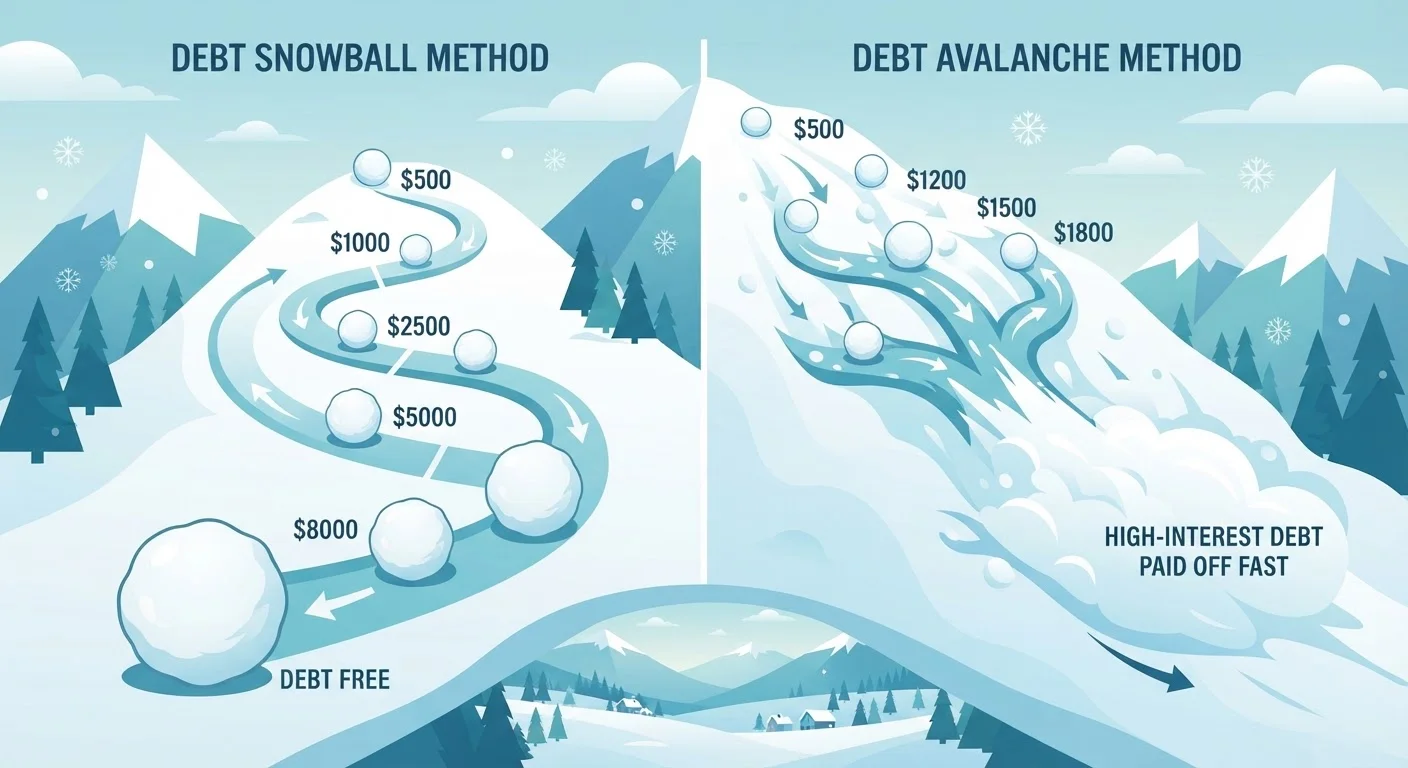
Photo: InsightsTurbo.com | Kickstart Your Knowledge Quest editorial
Key Takeaways
- The avalanche method targets the highest-interest debt first, minimizing total interest paid over time.
- The snowball method pays off the smallest balances first, building momentum through early wins.
- The mathematically optimal choice is the avalanche method, but the snowball method can be more sustainable for some people.
- Either method requires a consistent extra payment beyond your minimums to make meaningful progress.
- Choosing the method you'll actually stick with often matters more than which one looks better on paper.
The Core Idea Behind Each Method
Both the debt avalanche and debt snowball are structured repayment strategies built on the same foundation: you make minimum payments on all your debts, then direct any extra money toward one specific debt at a time. What differs is which debt you target first.
With the debt avalanche, you rank your debts by interest rate and attack the highest-rate balance first. Once it's gone, you roll that freed-up payment into the next highest-rate debt, and so on — like a snowball of cash cascading down the list.
With the debt snowball, you rank your debts by balance size and pay off the smallest one first, regardless of its interest rate. Each eliminated account creates a psychological win, and you redirect that payment to the next smallest balance.
Both approaches fit naturally within a broader spending plan. If you haven't mapped out where your money goes each month, the budgeting methods guide can help you find a framework that makes room for extra debt payments.
How They Compare Side by Side
The table below illustrates the key differences across the dimensions that matter most for most borrowers.
| Debt Avalanche | Debt Snowball | |
|---|---|---|
| Repayment order | Highest interest rate first | Smallest balance first |
| Total interest paid | Lower over time | Potentially higher |
| Time to first payoff | Longer if top debt is large | Faster — smallest balance first |
| Psychological benefit | Abstract savings motivation | Concrete early wins |
| Best suited for | Math-driven, patient planners | Motivation-driven, habit builders |
| Complexity | Slightly more tracking required | Simple and intuitive |
Consider a simplified example: you have three debts — a $500 medical bill at 0% interest, a $3,000 credit card at 22% APR, and a $7,000 personal loan at 11% APR. The avalanche method sends extra money to the credit card first. The snowball method clears the medical bill first, then the personal loan, and lastly the credit card.
In most scenarios like this, the avalanche method results in less total interest paid. But the snowball method offers a faster first victory, which matters more than many people expect.
The Math: What Interest Costs You
20%+
Typical APR on credit card debt
The Federal Reserve has reported average credit card interest rates consistently above 20% in recent years, underscoring the cost of carrying balances.
$6,500+
Average U.S. credit card balance per holder
According to data from the Federal Reserve Bank of New York, per-holder credit card balances have risen steadily in recent years.
Interest is the real cost of carrying debt, and high-interest balances — particularly credit cards — can grow faster than you pay them down if you only make minimums. This is exactly why high-interest debt often deserves priority over long-term savings.
The avalanche method addresses this directly. By cutting off the most expensive debt source first, you reduce the amount of interest accruing month by month. Over a multi-year repayment timeline, that difference can be hundreds or even thousands of dollars depending on your balances and rates.
The snowball method doesn't ignore this cost — it just accepts some additional interest in exchange for behavioral benefits. For people who've tried and abandoned repayment plans before, that trade can be entirely rational.
This article is for general informational purposes only and does not constitute personalized financial advice. Consider speaking with a licensed financial counselor or advisor about your specific situation.
The Psychology: Why Motivation Matters
Research in behavioral economics suggests that people are motivated by visible progress and a sense of completion — sometimes more than by abstract future savings. The debt snowball exploits this tendency deliberately. Eliminating an account entirely feels different from reducing a large balance by a small percentage, even if the dollar amounts are similar.
This is not a flaw. If a plan you can sustain for three years beats a plan you abandon in six months, the sustainable plan wins — even with slightly higher interest costs.
Try a Hybrid Approach
That said, the avalanche method suits people who are comfortable with delayed gratification and can stay focused on long-term financial outcomes. If you track your net worth or interest charges regularly, watching those numbers move can provide its own motivation.
If your debts are complex — multiple lenders, variable rates, or large balances — you might also explore whether debt consolidation could simplify your repayment picture before choosing a method.
For borrowers managing student loans alongside consumer debt, the dynamics shift further. The guide to balancing student loan repayment and savings walks through the specific trade-offs involved.
Choosing the Right Approach for You
Neither method is universally superior. The right choice depends on your debt profile, your personality, and your financial goals.
- If your highest-interest debt also has a high balance: The avalanche method is likely your best path — you'll feel progress through interest savings even before that first account closes.
- If you've struggled with motivation: The snowball method's early wins can reset your relationship with debt repayment. A quick first payoff often unlocks renewed commitment.
- If balances and rates are similar: The two methods may produce nearly identical results; pick the one that feels more intuitive.
Whichever method you choose, the most important variable is consistency. Extra payments — even small ones — compound in your favor over time, just as interest compounds against you. Review your budgeting basics regularly to make sure your repayment plan stays aligned with your income and expenses.
The content provided on our blog site traverses numerous categories, offering readers valuable and practical information. Readers can use the editorial team’s research and data to gain more insights into their topics of interest. However, they are requested not to treat the articles as conclusive. The website team cannot be held responsible for differences in data or inaccuracies found across other platforms. Please also note that the site might also miss out on various schemes and offers available that the readers may find more beneficial than the ones we cover.