
Debt Consolidation: What It Is, How It Works, and When It Makes Sense

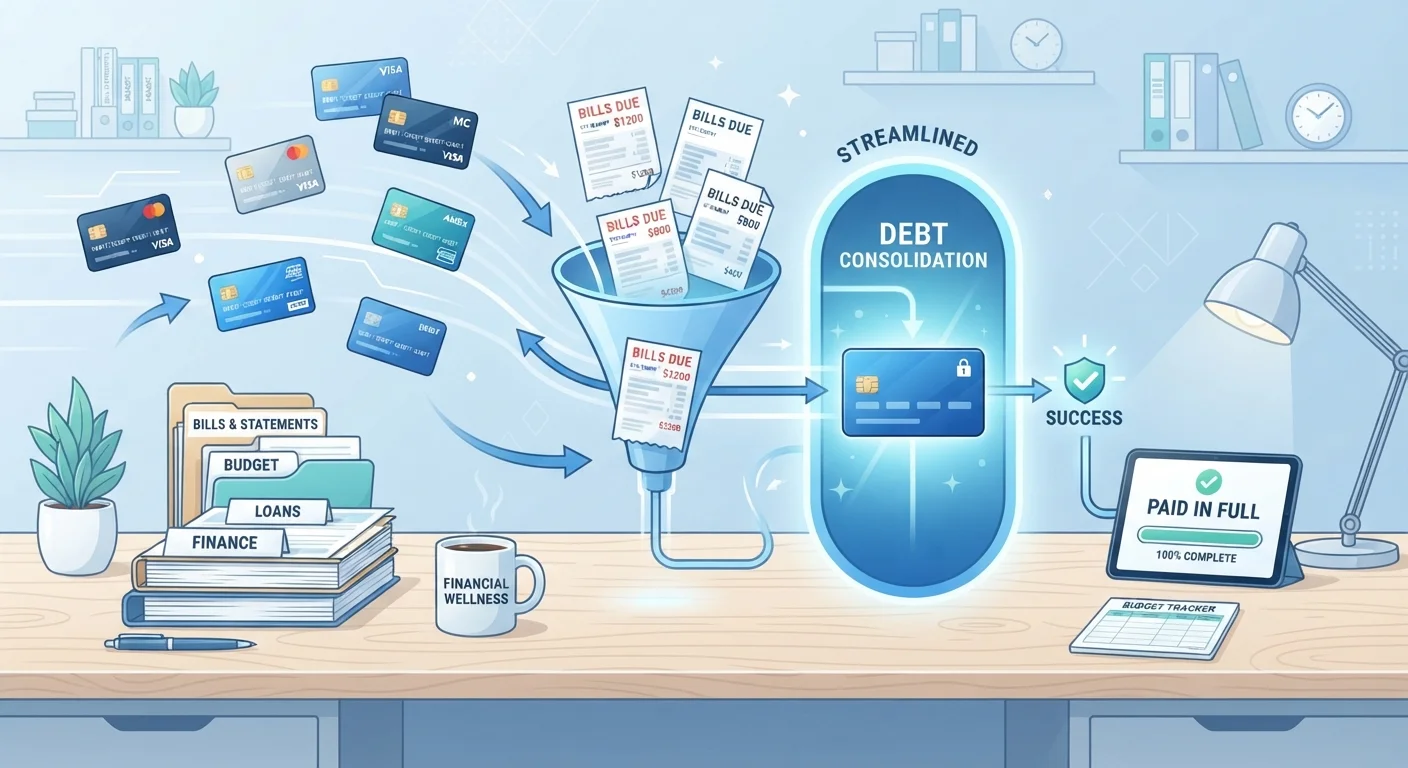
Photo: InsightsTurbo.com | Kickstart Your Knowledge Quest editorial
Key Takeaways
- Debt consolidation combines multiple debts into one payment but does not reduce the amount owed.
- A lower interest rate is the primary financial benefit — but it's not guaranteed for every borrower.
- Your credit score significantly affects whether you qualify for favorable consolidation terms.
- Consolidation can extend your repayment period, potentially increasing total interest paid over time.
- It works best when paired with a realistic budget to avoid accumulating new debt.
- Alternatives like the avalanche or snowball methods may be more suitable depending on your situation.
How Debt Consolidation Actually Works
When you consolidate debt, a lender pays off your existing balances and you begin repaying that lender under a new set of terms — ideally a lower interest rate and a single monthly payment. The mechanics depend on which consolidation method you use.
Personal loans are a common route. You borrow a lump sum, pay off your existing debts, then repay the loan in fixed monthly installments. The rate you receive depends heavily on your credit profile.
Balance transfer credit cards let you move high-interest credit card balances to a new card, often with a 0% promotional APR for an introductory period — typically 12 to 21 months. If you pay off the balance within that window, you can avoid interest entirely. A balance transfer fee (commonly 3–5% of the transferred amount) usually applies.
Debt management plans (DMPs) are offered through nonprofit credit counseling agencies. You make one payment to the agency each month, and it distributes funds to your creditors — often after negotiating reduced interest rates on your behalf. This option doesn't involve taking on a new loan.
Before exploring any path, it helps to be familiar with core terminology. Our guide to key debt terms explains concepts like APR, principal, and amortization in plain language.
~$7,200
Average U.S. credit card balance per borrower
According to Federal Reserve and TransUnion data, the average indebted U.S. cardholder carries thousands in revolving credit card debt — a common driver behind consolidation interest.
20%+
Average credit card APR in recent years
The Federal Reserve has reported average credit card interest rates consistently above 20% in recent years, making high-interest debt particularly costly to carry long-term.
3–5%
Typical balance transfer fee
Most balance transfer offers charge a one-time fee of 3–5% of the transferred amount, which should be factored into any cost comparison.
When Consolidation Makes Financial Sense
Consolidation can be a smart move under the right conditions — but it isn't universally beneficial. Here's when it tends to work in a borrower's favor:
- You qualify for a meaningfully lower interest rate. If your current debts carry rates of 20–25% and you can secure a consolidation loan at 12%, the math generally works in your favor — assuming you don't extend the term dramatically.
- You're managing multiple payments and struggling to track them. Simplifying to one payment reduces the risk of missing due dates, which protects your credit and avoids late fees.
- You have a stable income and a realistic repayment plan. Consolidation restructures debt — it doesn't eliminate it. Without a budget in place, you risk accumulating new balances on the accounts you just paid off.
Understand, too, that high-interest debt is usually worth addressing aggressively regardless of consolidation. Our article on prioritizing high-interest debt before long-term savings explains the reasoning behind that order of operations.
Calculate Total Cost, Not Just Monthly Payments
When It Might Not Be the Right Move
Consolidation has real drawbacks that are easy to overlook when you're focused on simplifying payments.
A longer term can cost more overall. Spreading $10,000 in debt over five years instead of two keeps monthly payments lower — but you'll pay more interest in total, even at a reduced rate. Always calculate the full repayment cost, not just the monthly figure.
Fees can erode the benefit. Origination fees on personal loans, balance transfer fees, and annual fees on new cards all reduce the net savings from consolidation.
It doesn't address the root cause. If overspending or insufficient income contributed to the debt, consolidation alone won't change that dynamic. Without behavioral changes, many borrowers accumulate new debt after consolidating. This is one of the financial decisions that make getting out of debt harder.
If your debt is manageable and you're disciplined, structured repayment strategies — like the avalanche and snowball methods — may achieve similar results without requiring new credit.
Steps to Take Before Deciding
If you're considering consolidation, a methodical approach helps you avoid costly mistakes.
- List all your debts. Write down each balance, interest rate, minimum payment, and remaining term. This gives you a clear picture of what you're working with.
- Check your credit score and report. Your score determines whether you'll qualify for favorable rates. Review your report for errors that could be dragging your score down. The Credit Essentials hub covers what you need to know about credit reports and scores.
- Run the numbers. Compare the total cost of your current debts (interest + fees over remaining term) against the total cost of the proposed consolidation loan. Don't rely on monthly payment comparisons alone.
- Read the fine print. Look for origination fees, prepayment penalties, variable vs. fixed rates, and what happens if you miss a payment.
- Consider consulting a nonprofit credit counselor. HUD-approved and NFCC-affiliated agencies offer free or low-cost guidance without selling you products.
This article is for general informational and educational purposes only and does not constitute personalized financial, legal, or tax advice. Consult a qualified financial professional before making decisions about your specific debt situation.
Frequently Asked Questions
The content provided on our blog site traverses numerous categories, offering readers valuable and practical information. Readers can use the editorial team’s research and data to gain more insights into their topics of interest. However, they are requested not to treat the articles as conclusive. The website team cannot be held responsible for differences in data or inaccuracies found across other platforms. Please also note that the site might also miss out on various schemes and offers available that the readers may find more beneficial than the ones we cover.