
Japan vs. South Korea: Which Destination Fits Your Travel Style?

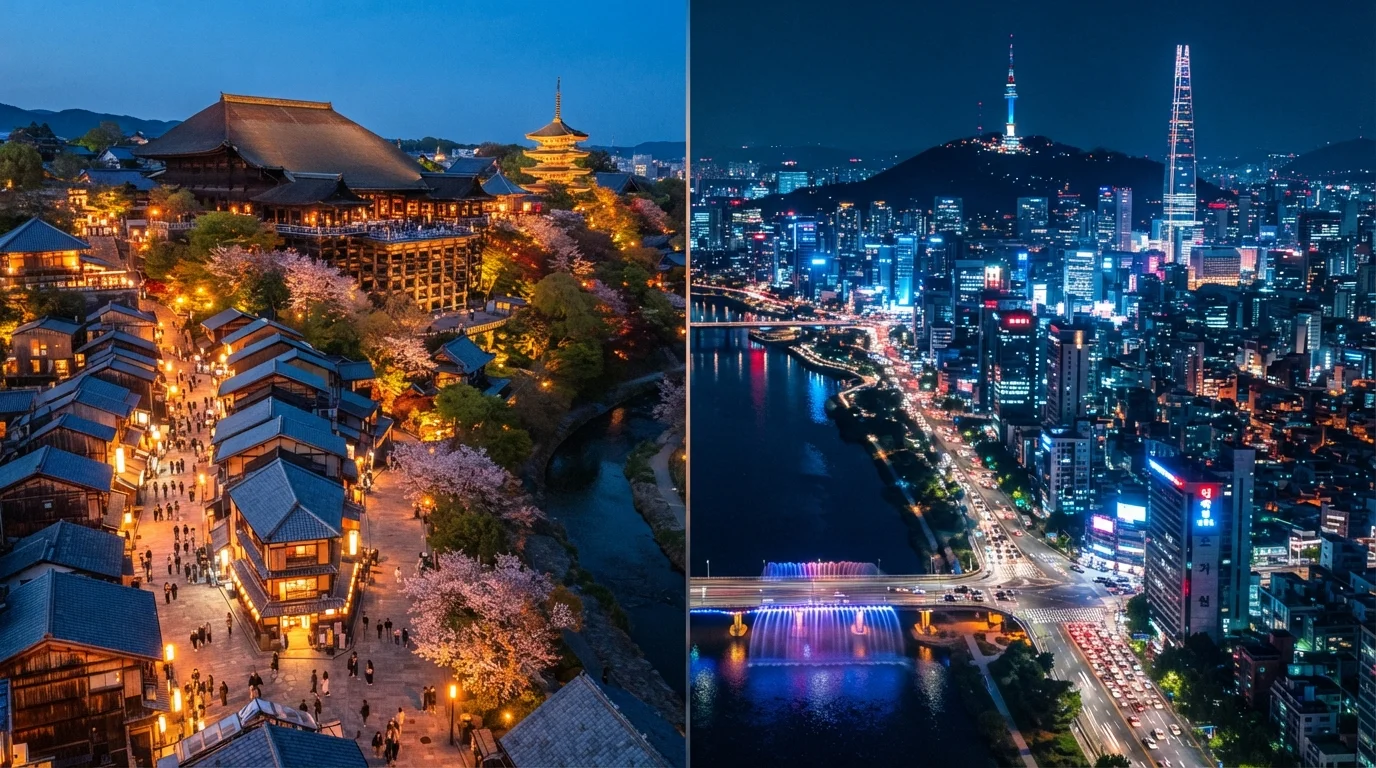
Photo: InsightsTurbo.com | Kickstart Your Knowledge Quest editorial
Key Takeaways
- Japan typically costs more than South Korea, especially for accommodation and transport between cities.
- South Korea's transit system is highly efficient and English-signage is widespread in major cities.
- Japan offers greater geographic and cultural diversity across a longer itinerary.
- South Korea is easier to explore thoroughly in a shorter trip, particularly around Seoul and Busan.
- Both countries are considered very safe, well-organized destinations for independent travelers.
- Your ideal pick depends heavily on pacing preference, budget, and cultural interests.
Culture and Atmosphere: Ancient Traditions vs. Modern Energy
Japan's cultural identity is layered and slow to reveal itself. Shinto shrines sit beside bullet-train stations; tea ceremonies coexist with robot restaurants. Traveling here often means navigating a respectful, rule-conscious society where cultural etiquette — removing shoes, queueing quietly, avoiding phone calls on trains — is quietly observed and appreciated by locals.
South Korea pulses with a different kind of energy. Seoul, in particular, feels electric: K-pop culture, beauty trends, and a thriving digital-native food scene have made it one of Asia's most talked-about cities. Korean culture is simultaneously proud of its deep Confucian roots and enthusiastically forward-looking. Palaces like Gyeongbokgung sit just blocks from trendy café districts in Insadong and Hongdae.
If you're drawn to quiet contemplation, historic preservation, and a sense of stepping into a carefully maintained past, Japan is likely your fit. If you want somewhere that feels alive with contemporary creativity while still honoring its history, South Korea is hard to beat. For a broader comparison of how travel pacing affects your experience, see our guide to city breaks vs. slow travel.
| Criterion | Japan | South Korea |
|---|---|---|
| Overall trip cost | Higher (mid-to-premium range) | Moderate (budget-friendly options widely available) |
| Intercity transport | Shinkansen (fast, expensive) | KTX trains (fast, affordable) |
| English accessibility | Good in cities, limited rurally | Strong in Seoul and major cities |
| Ideal trip length | 10–14+ days | 7–10 days |
| Food style | Refined, regional, precise | Bold, communal, street-food-rich |
| Cultural focus | Traditional heritage and zen aesthetics | Contemporary culture with historic roots |
| Best for first-timers | With some planning | Very first-timer friendly |
Cost, Transit, and Practical Logistics
Japan is not a budget destination. The shinkansen (bullet train) network is world-class but pricey — a Tokyo-to-Kyoto round trip can run $100–$150 USD without a rail pass. Accommodation, particularly in cities like Kyoto and Tokyo, trends expensive. That said, convenience stores (konbini) offer genuinely good, affordable meals, and many cultural sites have modest entrance fees.
South Korea stretches a travel budget further. Intercity KTX trains between Seoul and Busan are fast and reasonably priced, and Seoul's metro is one of the most affordable and intuitive in the world. Street food staples — tteokbokki, kimbap, Korean fried chicken — are plentiful and cheap. Accommodation ranges from well-equipped hostels to hanok guesthouses (traditional Korean houses) at various price points. Our accommodation trade-offs guide breaks down what to consider when choosing where to stay in either country.
~31M
International visitors to South Korea annually
South Korea's tourism authority reported approximately 17.5 million inbound visitors in 2019, a figure recovering strongly post-pandemic — making it one of Asia's fastest-growing destinations.
~47M
Annual international arrivals to Japan pre-pandemic
Japan Tourism Agency data showed record-breaking inbound tourism in 2019, driven by strong interest across all world regions.
$60–$120
Estimated daily budget per traveler in Japan (USD)
General travel resource estimates suggest a mid-range daily spend for accommodation, transit, and meals in Japan; Tokyo and Kyoto sit at the higher end.
Both countries have excellent English-language support in tourist-heavy areas, though Japan's rural regions can be harder to navigate without basic Japanese phrases. South Korea's T-money transit card works across buses and metros nationwide — a simple, seamless system for first-timers.
Food, Pacing, and Who Each Destination Really Suits
Japan's food culture rewards patience and exploration. Ramen shops with regional variations, kaiseki multi-course dining, conveyor-belt sushi, and street yakitori stalls each represent distinct traditions. Japanese food is precise, often minimalist, and deeply tied to season and place.
South Korea's food scene is bolder and more communal. Banchan (shared side dishes), sizzling Korean BBQ, spicy soups, and an extraordinary variety of street snacks define meals that are social events as much as sustenance. The food is accessible, interactive, and endlessly shareable.
On pacing: Japan rewards longer trips. Moving between regions — Tokyo, Osaka, Kyoto, Hiroshima, Nara — takes time but pays off. South Korea is more compact; a focused 7-day trip can cover Seoul, a day trip to the DMZ, and a stay in Busan without feeling rushed. If you're still weighing which region of the world to tackle first, our Southeast Asia vs. Central America comparison may also help calibrate your thinking.
Visa and Entry Requirements Vary
Both destinations require checking current entry requirements, visa conditions, and any travel advisories with official government sources before booking — conditions can change, and it's always worth verifying directly.
The content provided on our blog site traverses numerous categories, offering readers valuable and practical information. Readers can use the editorial team’s research and data to gain more insights into their topics of interest. However, they are requested not to treat the articles as conclusive. The website team cannot be held responsible for differences in data or inaccuracies found across other platforms. Please also note that the site might also miss out on various schemes and offers available that the readers may find more beneficial than the ones we cover.