
Flat-Pack Furniture: What to Know Before You Buy a Box

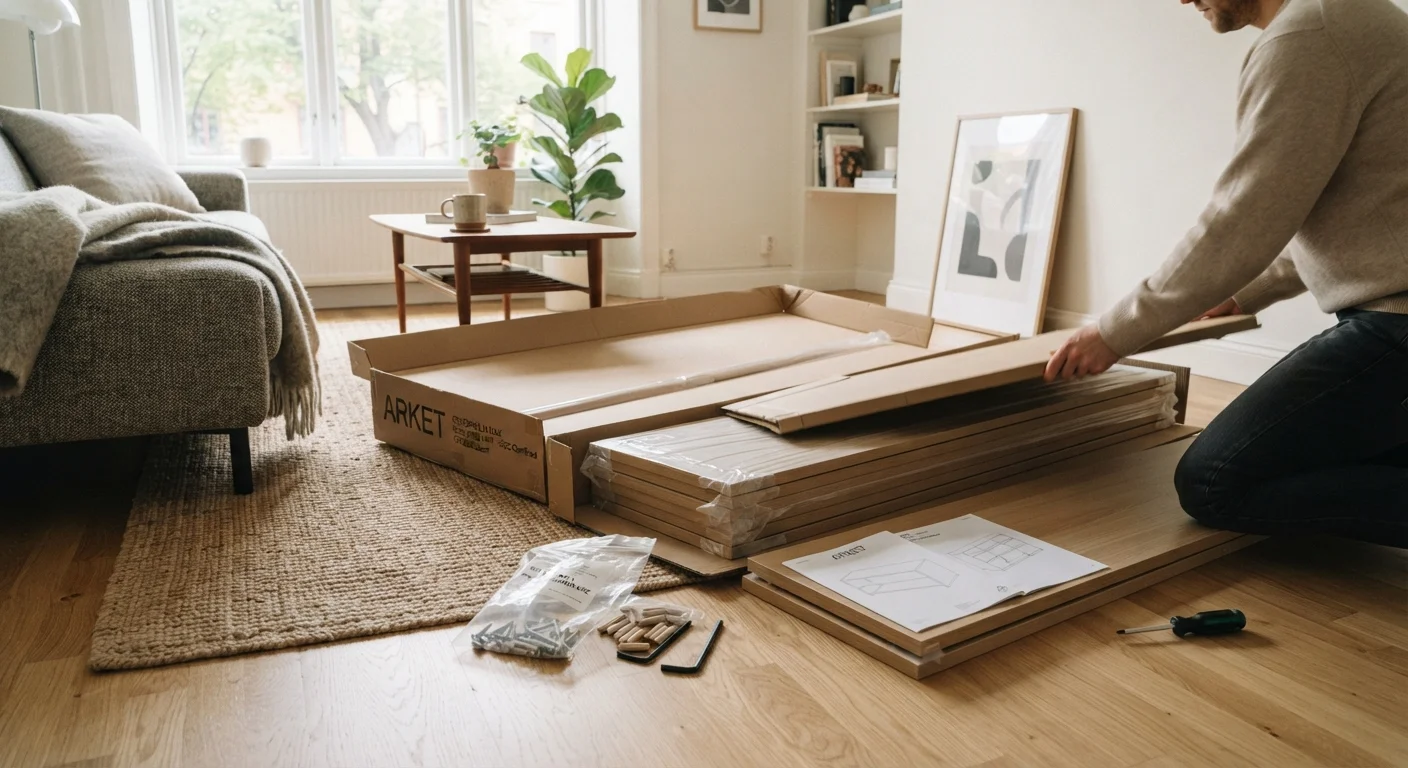
Photo: InsightsTurbo.com | Kickstart Your Knowledge Quest editorial
Key Takeaways
- Flat-pack furniture is significantly cheaper than assembled alternatives, making it ideal for budget-conscious first-time renters.
- Assembly quality varies widely - poorly assembled pieces can compromise durability and safety.
- Most flat-pack furniture is not built for repeated disassembly and reassembly across multiple moves.
- Choosing the right pieces for the right rooms can make flat-pack a smart, practical choice.
- Weight capacity and material quality should always be checked before purchasing.
Lower upfront cost than pre-assembled alternatives
Flat-pack furniture typically costs less because it eliminates factory assembly labor and reduces shipping volume, making it accessible for people furnishing a first home on a tight budget.
Easier to transport through tight spaces
Flat boxes navigate narrow hallways, stairwells, and doorways that would stop pre-assembled furniture cold - a genuine advantage in urban apartments.
Wide variety of styles and configurations
Flat-pack ranges from minimal Scandinavian aesthetics to more traditional looks, and many modular systems let you combine units to fit your specific space.
No professional delivery assembly usually required
Most pieces can be assembled with basic tools and one other person, skipping the cost and scheduling hassle of professional furniture delivery and setup.
Particleboard and MDF are less durable than solid wood
Engineered wood products used in most flat-pack furniture are more vulnerable to moisture, heavy loads, and physical impact than solid wood, which can shorten the usable lifespan of a piece.
Not designed for repeated disassembly
The cam locks, dowels, and short screws in flat-pack furniture are engineered for a single assembly. Taking pieces apart for a move and reassembling them weakens joints noticeably over time.
Assembly takes real time and effort
Complex pieces like wardrobes or multi-drawer dressers can take several hours to assemble and often go wrong when instructions are unclear or a step is missed early in the process.
Harder to repair if damaged
Stripped screw holes in particleboard are difficult to fix reliably, and replacement hardware can be hard to source once a product line is discontinued.
What Flat-Pack Furniture Actually Is
Flat-pack furniture - sometimes called ready-to-assemble (RTA) furniture - arrives unassembled in a flat box. You provide the labor; the manufacturer provides the parts, hardware, and instructions. It's the dominant format at large furniture retailers because it dramatically reduces shipping costs and storage footprint, savings that are (at least partly) passed on to buyers.
Most flat-pack pieces are made from engineered wood products like particleboard or medium-density fiberboard (MDF), often with a laminate or veneer surface. Some higher-end flat-pack uses solid wood for structural components. Understanding what's inside the box matters - particleboard, for example, doesn't hold screws as securely as solid wood, which affects both assembly and long-term stability.
If you're weighing all your furniture options, including whether to buy at all, see our comparison of renting vs. buying furniture when starting out.
A Note on Weight Ratings
The Real Advantages
Cost is the most obvious upside. Flat-pack pieces consistently cost less than comparable pre-assembled furniture - sometimes by a significant margin - which matters when you're furnishing an entire apartment from scratch. The savings free up budget for pieces where quality actually counts.
Lower upfront cost than pre-assembled alternatives
Flat-pack furniture typically costs less because it eliminates factory assembly labor and reduces shipping volume, making it accessible for people furnishing a first home on a tight budget.
Easier to transport through tight spaces
Flat boxes navigate narrow hallways, stairwells, and doorways that would stop pre-assembled furniture cold - a genuine advantage in urban apartments.
Wide variety of styles and configurations
Flat-pack ranges from minimal Scandinavian aesthetics to more traditional looks, and many modular systems let you combine units to fit your specific space.
No professional delivery assembly usually required
Most pieces can be assembled with basic tools and one other person, skipping the cost and scheduling hassle of professional furniture delivery and setup.
Flat-pack is also practical for people in apartments without elevators or with narrow hallways. A box that fits through a standard door is a lot easier to manage than a fully assembled sofa or bookcase. And because delivery often just means dropping a box, shipping is cheaper and more predictable.
Storage is another underrated perk. If a piece isn't needed immediately, a flat box stores against a wall far more conveniently than assembled furniture. For more ideas on working with limited space, check out storage approaches that work in small spaces.
The Trade-Offs Worth Knowing
Durability is where flat-pack furniture earns its criticism. Particleboard and MDF are moisture-sensitive - a bathroom cabinet or kitchen piece in a humid environment can swell or delaminate over time. Even in dry conditions, heavy daily use can stress joints that were designed for initial assembly, not decades of load-bearing.
Particleboard and MDF are less durable than solid wood
Engineered wood products used in most flat-pack furniture are more vulnerable to moisture, heavy loads, and physical impact than solid wood, which can shorten the usable lifespan of a piece.
Not designed for repeated disassembly
The cam locks, dowels, and short screws in flat-pack furniture are engineered for a single assembly. Taking pieces apart for a move and reassembling them weakens joints noticeably over time.
Assembly takes real time and effort
Complex pieces like wardrobes or multi-drawer dressers can take several hours to assemble and often go wrong when instructions are unclear or a step is missed early in the process.
Harder to repair if damaged
Stripped screw holes in particleboard are difficult to fix reliably, and replacement hardware can be hard to source once a product line is discontinued.
Assembly itself is a real time commitment. Instructions vary from clear to genuinely confusing, and a wrong step early on (like tightening a cam lock before positioning another panel) can mean partial disassembly. Budget at least an hour for simple pieces; complex storage units can take three or more.
Repeat moves are another weak point. Flat-pack furniture is engineered to be assembled once. Disassembling and reassembling a bookcase or bed frame for a second or third apartment stresses the joints and hardware - screws strip, dowels loosen, and the piece rarely goes back together as solidly as it did the first time.
Where to Use It - and Where to Spend More
Not every piece of furniture deserves the same budget, and flat-pack fits some categories much better than others. It excels for storage (bookshelves, media units, dressers), decorative items, and lower-use pieces like side tables or occasional chairs. These items don't absorb daily punishment the way a desk chair, bed frame, or sofa does.
~65%
Share of US furniture sales that are RTA or flat-pack
Industry estimates suggest ready-to-assemble furniture accounts for a substantial majority of volume furniture sales in the United States, driven largely by affordability.
2-5 years
Typical useful lifespan of particleboard flat-pack pieces
Consumer durability reports generally suggest that particleboard furniture used daily lasts two to five years before joints and surfaces show significant wear, depending on usage and environment.
For pieces you use every day or that need to support significant weight - a mattress foundation, a work-from-home desk chair, a couch - quality typically pays off in longevity and comfort. Our guide on which furniture pieces are worth spending more on walks through that thinking in detail.
When shopping, always check the listed weight capacity and read user reviews specifically mentioning long-term durability - not just ease of assembly. Photos of pieces after a year or two of use tell you far more than out-of-the-box impressions.
The content provided on our blog site traverses numerous categories, offering readers valuable and practical information. Readers can use the editorial team’s research and data to gain more insights into their topics of interest. However, they are requested not to treat the articles as conclusive. The website team cannot be held responsible for differences in data or inaccuracies found across other platforms. Please also note that the site might also miss out on various schemes and offers available that the readers may find more beneficial than the ones we cover.